South African President Cyril Ramaphosa has responded firmly to the United States government’s decision to boycott the upcoming Group of 20 summit in Johannesburg, describing the move as “their loss” and asserting that the gathering of world leaders will proceed regardless of American absence.
Speaking to reporters outside the South African Parliament on Wednesday, President Ramaphosa stated that boycott politics do not work based on his experience. The G20 summit, scheduled for November 22-23 in Johannesburg, marks the first time the influential economic forum will be hosted on African soil.
US President Donald Trump announced on Friday via his Truth Social platform that no American government officials would attend the summit, citing what he termed a “total disgrace” regarding South Africa’s hosting of the event. Initially, Vice President JD Vance had been scheduled to represent the United States, but those plans were subsequently cancelled.
The diplomatic standoff centers on several contentious issues. Trump has repeatedly claimed that white South Africans, particularly Afrikaners descended from Dutch, French, and German settlers, are facing violent persecution and illegal land confiscation. These allegations have been categorically rejected by the South African government and prominent Afrikaner leaders.
Chrispin Phiri, spokesman for South Africa’s Department of International Relations, told NPR that the summit would be one of the most significant G20 gatherings to date, despite the US absence. The summit will feature European heads of state, with Chinese President Xi Jinping expected to attend.
President Ramaphosa emphasized that the United States is relinquishing its crucial role as the world’s largest economy by choosing not to participate. The G20, established in 1999, brings together leaders from 19 of the world’s wealthiest and leading developing economies, along with the European Union and African Union, to address global economic challenges and international development.
Beyond the disputed claims about treatment of white South Africans, tensions have escalated over South Africa’s legal action at the International Court of Justice. South Africa filed a comprehensive memorial of over 750 pages to the ICJ in October 2024, presenting evidence in support of its genocide case against Israel concerning actions in Gaza. The case, initiated in 2023, accuses Israel of violating the Genocide Convention.
The ICJ has issued three provisional measures ordering Israel to prevent genocidal acts and allow humanitarian aid into Gaza. Israel is scheduled to submit its counterarguments by January 12, with oral hearings anticipated in 2027 and a final judgment expected in late 2027 or early 2028.
President Ramaphosa recently stated that the current Gaza ceasefire would not affect South Africa’s determination to pursue the case, despite the truce being part of a US-backed peace plan.
The Trump administration has criticized South Africa’s G20 hosting from the outset, with Secretary of State Marco Rubio boycotting a G20 foreign ministers meeting in South Africa in February. Rubio derided the country’s G20 theme of “solidarity, equality and sustainability,” characterizing South Africa’s policies as “anti-Americanism”.
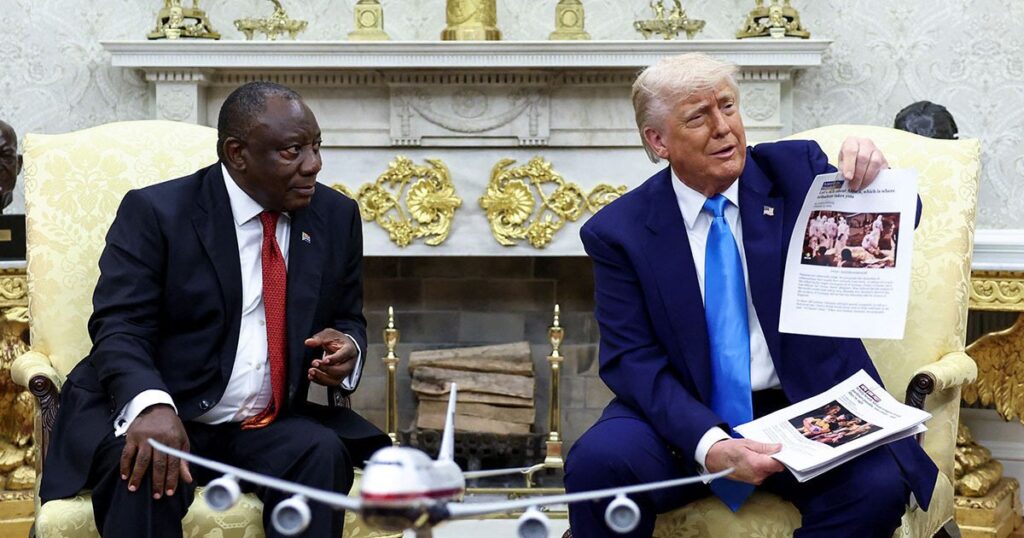
Trump previously confronted President Ramaphosa during a White House meeting in May, presenting what were later identified as unverified claims about violence against white South Africans. During that same meeting, Ramaphosa had lobbied for Trump’s attendance at the historic African-hosted G20 summit.
Prominent Afrikaner leaders have publicly rejected Trump’s characterization of their situation. One Afrikaner representative stated it was important for all South Africans to unite and refute Trump’s statements, calling them “simply not true”.
Trump and supporters, including South African-born businessman Elon Musk, have also criticized the country’s affirmative action laws, which aim to advance opportunities for the Black majority population that endured oppression under apartheid, South Africa’s former system of racial segregation that ended in 1994.
The South African government has attributed Trump’s comments to misinformation and insufficient understanding of the country’s actual conditions and policies.
Relations between Washington and Pretoria have deteriorated to their lowest point since the end of apartheid. In March, the United States expelled South Africa’s ambassador following controversial remarks about the Trump administration.
The United States is scheduled to assume the rotating presidency of the G20 from South Africa at the end of 2025, potentially hosting the next summit in Miami, Florida, as Trump indicated in his announcement.