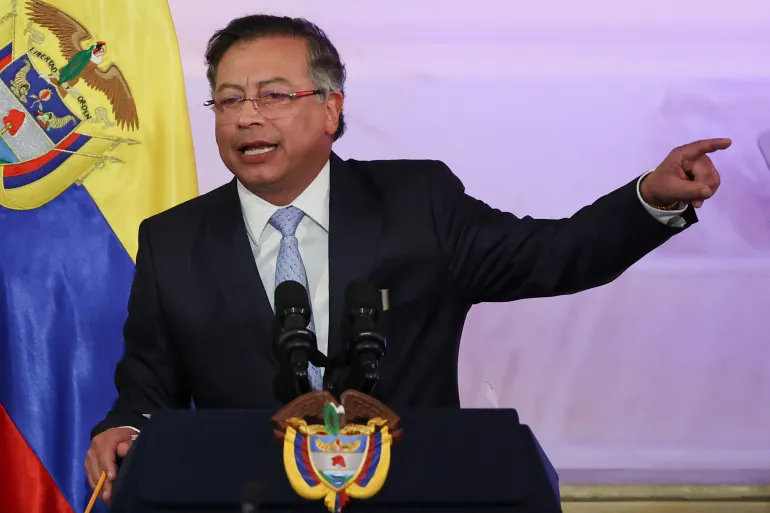
President Gustavo Petro of Colombia has directed his country’s security apparatus to immediately cease all intelligence cooperation with United States agencies, citing Washington’s continued lethal military operations against vessels in Caribbean waters.
The Colombian leader announced the suspension on Tuesday via social media platform X, declaring that the measure would persist “as long as the missile attacks on boats continue.” The directive affects all levels of Colombia’s public security forces and their communications with American security counterparts.
Petro emphasized that “the fight against drugs must be subordinated to the human rights of the Caribbean people,” drawing attention to what critics have characterized as extrajudicial killings in international waters.
The decision comes as British authorities have taken similar action. The United Kingdom suspended intelligence sharing with the United States regarding suspected drug trafficking vessels in the Caribbean over a month ago, with sources indicating that London considers the American strikes illegal and does not wish to be complicit in the operations.
United States military operations in the region have resulted in at least 76 confirmed deaths since strikes commenced in September, with victims including nationals from Venezuela, Ecuador, Colombia, and Trinidad and Tobago. The Trump administration maintains these operations target drug trafficking vessels operated by designated terrorist organizations.
President Petro has been particularly vocal about the human cost of the campaign. During a Latin American and European Union leadership summit hosted by Colombia on Sunday, Petro recounted meeting with relatives of a Colombian fisherman allegedly killed in one of the strikes, stating: “He may have been carrying fish, or he may have been carrying cocaine, but he had not been sentenced to death. There was no need to murder him.”
The leftist Colombian leader has called for President Donald Trump to face investigation for war crimes, arguing that American drug policy unfairly targets impoverished coca farmers rather than addressing major trafficking networks and money laundering operations.
Washington has countered these criticisms by accusing President Petro of being lenient toward drug traffickers. United States Treasury Secretary Scott Bessent stated in October that Petro “has allowed drug cartels to flourish and refused to stop this activity,” adding that “President Trump is taking strong action to protect our nation.”
The Treasury Department imposed sanctions on President Petro, his immediate family members, and Colombia’s Interior Minister, Armando Benedetti, over allegations of inadequately controlling cocaine production and shielding criminal organizations from accountability.
This latest diplomatic rupture follows previous confrontations between the two leaders. In September, Washington revoked President Petro’s visa, citing what American officials described as “reckless and incendiary actions” during his attendance at the United Nations General Assembly in New York. While addressing protesters outside UN headquarters demonstrating against Israel’s military operations in Gaza, Petro urged American soldiers to “disobey the orders of Trump” and instead “obey the orders of humanity.”
The intelligence suspension coincides with heightened American military activity in the Caribbean. The Pentagon confirmed that the Gerald R Ford Carrier Strike Group, featuring the world’s largest aircraft carrier with approximately 4,000 sailors and tactical aircraft aboard, has arrived in Caribbean waters. The deployment has fueled speculation about potential escalation of military operations, particularly concerning Venezuela under President Nicolas Maduro, whom the Trump administration considers a primary target.
The United Nations human rights chief, Volker Turk, declared last month that the strikes violate international law and constitute extrajudicial killing, an assessment shared by British officials.
Canada has similarly distanced itself from the operations, making clear to Washington that it opposes its intelligence being utilized to facilitate deadly strikes, though it has not completely severed cooperation like the United Kingdom.
The deteriorating relationship between Bogota and Washington represents a significant shift for nations that were once close partners in counter-narcotics efforts. The suspension of intelligence sharing marks one of the most serious diplomatic crises between the two countries in recent decades, with profound implications for regional security cooperation.