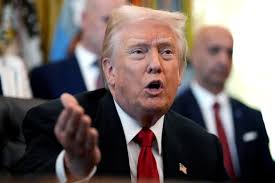
United States President Donald Trump declared a win on Tuesday following a bipartisan agreement in the Senate that sets the stage for ending the nation’s longest government shutdown, now in its 41st day.
The President made his remarks during the annual Veterans Day ceremony at Arlington National Cemetery on Tuesday, November 11, where he acknowledged Republican House Speaker Mike Johnson, who was present at the event.
“Congratulations on a very big victory,” Trump told Johnson from the podium. “We’re opening up our country. It should have never been closed,” the President added.
The Senate passed the funding bill on Monday night in a 60-40 vote, with eight Democratic senators breaking ranks to support the Republican-backed measure. The Democrats who voted for the agreement were Senators Dick Durbin, Angus King, Maggie Hassan, Jeanne Shaheen, Catherine Cortez Masto, Jacky Rosen, John Fetterman, and Tim Kaine.
The agreement was brokered by Senators Jeanne Shaheen of New Hampshire, Maggie Hassan of New Hampshire, and Angus King of Maine, and received approval from Senate Majority Leader John Thune.
The legislation, which funds government operations through January 30, now heads to the House of Representatives for consideration, with voting potentially scheduled for Wednesday. If approved, the bill would require President Trump’s signature to officially end the shutdown.
The prolonged funding lapse has created significant hardship across the country. Over 2,000 flights were cancelled on Sunday alone as the Federal Aviation Administration imposed restrictions on private flights at major airports due to staffing shortages. Approximately one million federal workers have gone without pay, and food assistance programs serving 42 million Americans through SNAP (Supplemental Nutrition Assistance Program) have been disrupted.
The deal reverses the Trump administration’s attempted layoffs of federal workers during the shutdown and guarantees back pay for furloughed employees.
However, the agreement has sparked controversy within the Democratic Party. The deal notably excludes an immediate extension of Affordable Care Act subsidies, which are set to expire in December and affect over 20 million Americans. Instead, Democrats secured only a promise that the Senate would vote on a bill to extend the subsidies by the second week of December.
Senate Minority Leader Chuck Schumer of New York opposed the deal. “This health care crisis is so severe, so urgent, so devastating for families back home, that I cannot in good faith support this continuing resolution that fails to address the health care crisis,” Schumer stated on Sunday.
The political pressure on both parties intensified following recent elections. Days before the deal was reached, Democratic candidates won significant victories in New York City, New Jersey, and Virginia, with multiple polls showing Americans largely blaming Trump and Republicans for the shutdown’s economic impact.
On Monday, President Trump affirmed his support for the agreement, stating he would honour the deal’s provisions, including the reversal of federal worker layoffs during the shutdown.
The 79-year-old President also continued his pattern of using ceremonial military events to make political statements. At the Veterans Day ceremony, he announced plans to rename the November 11 holiday as “Victory Day” to commemorate World War I, with similar plans for May 8 regarding World War II.
The House of Representatives, which has been in recess since September, has been instructed to return to Washington to vote on the measure. Congressional leaders remain cautiously optimistic that the legislation will pass and end the historic shutdown by Friday.